Yes, paver restoration can substantially improve a tired patio or walkway, but what it achieves depends on what is actually wrong. Organic growth and staining respond well to cleaning, while settlement, missing joint material, and drainage problems require repair. One clarification matters early: homeowners often say "brick pavers" when they mean concrete pavers, fired-clay brick, or natural stone, and the actual material should determine the restoration method.
Table of Contents
- What's actually wrong with your pavers?
- How should pavers be cleaned without damaging them?
- Why do paver joints matter as much as the pavers?
- When is cleaning not enough and repair needed?
- How do professionals protect plants, siding, and nearby surfaces during restoration?
- What should you realistically expect from paver restoration?
- How do you keep pavers looking good after restoration?
- Key Takeaways
- References
What's actually wrong with your pavers?
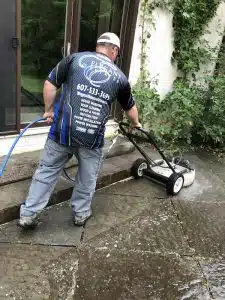
"Tired pavers" is a symptom, not a diagnosis. Organic growth such as algae, moss, and mildew creates a dull or slippery surface. Staining from rust, efflorescence, oil, or mineral deposits changes the color in specific areas. Missing or eroded joint material allows pavers to shift. Settled or shifting pavers indicate a base problem. Drainage issues show up as standing water or washouts. Each of these conditions calls for a different response, and many patios have more than one problem at once.
Heavy growth and staining can conceal defects underneath. A patio that looks merely dirty may reveal loose pavers, sunken edges, or cracked units once the surface is cleaned. That is why a close assessment comes before any recommendation. Elegant Estates of the Fingerlakes approaches paver work this way: look at what the pavement actually needs, then recommend cleaning, joint renewal, repair, or a combination. The terminology matters too. Concrete pavers, fired-clay brick, and natural stone behave differently under cleaning and repair methods, so the material should guide the approach.
How should pavers be cleaned without damaging them?
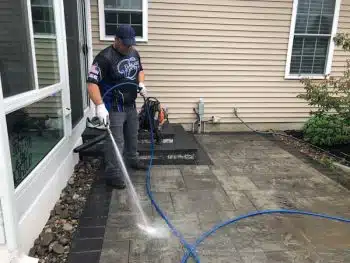
Responsible cleaning starts with matching the method to the paver, its condition, and the restoration goal. Excessive pressure or improper technique can damage paver surfaces, displace joint material, and strip what remains of the bedding. A one-size-fits-all pressure setting is not appropriate for every pavement. Soft washing uses lower pressure and cleaning solutions suited to organic growth on more delicate surfaces. Pressure washing may be appropriate for durable concrete surfaces when done with control and the right equipment.
Abrasive approaches are a specialist decision, not a default. According to Perfect Pavers, sandblasting removes up to 0.02 inch of paver material and operates at 6 to 8 atmospheres of pressure. That level of removal may be justified in specific cases, but it is not a routine cleaning step. Stain removal is not always a part of paver restoration. Rust, efflorescence, oil, and mineral deposits respond to targeted treatments, and results depend on the stain, the surface material, and how long the stain has been present. A knowledgeable provider evaluates the stain before choosing a method, and most times stain removal can be above and beyond the cost of paver restoration.
Why do paver joints matter as much as the pavers?
Joints are part of the pavement system, not just gaps between pavers. Joint preparation, material selection, and installation determine how well the whole surface holds together. According to This Old House, polymeric sand is swept into joints, vibrated down with a compactor, and misted with water to activate and lock it. That sequence matters. Skipping the compaction or the activation step leaves joints that fail early.
Polymeric and resin jointing products have different requirements. No single product suits every pavement, and the choice depends on joint width, paver type, drainage, and expected use. The common question of putting new polymeric sand over old has a conditional answer. Old joint material often needs removal or preparation first, because new sand cannot bond properly to a crumbling or contaminated layer. Missing joint sand lets pavers shift, invites weed growth, and accelerates erosion, so joints deserve the same attention as the paver surface itself.
When is cleaning not enough and paver repair needed?
Cleaning will not correct sinking pavers, loose edges, uneven steps, or poor drainage. Those conditions require evaluation and a separate repair scope. Repair work typically involves lifting and resetting affected sections, correcting base or bedding issues where appropriate, and checking the sand base. According to Perfect Pavers, a sand base should be checked to a depth of 15 to 20 centimeters, with sand laid in layers of 5 to 7 centimeters and tamped between layers. That kind of base work is not a cleaning task.
Crack damage up to roughly 0.11 to 0.15 inch can sometimes be addressed with polymer compounds, according to Perfect Pavers, but scope depends on the pavement. Paver restoration is not always the right choice. Some sections need more extensive rebuilding, and a good provider explains that plainly rather than promising a cleaning will fix a structural problem. The assessment should separate cosmetic issues from repair needs before any work begins.
Field Notes

Chris Negley
Owner, Elegant Estates of the Finger Lakes
Same lake house, two homeowners, one paver restoration
A homeowner called me for a paver restoration quote as she was getting ready to sell her lake home. I measured well over 6,000 square feet of pavers across six terraces that stepped down from the house to the shoreline. Once she saw the quote for the full project, she decided the cost was more than she wanted to take on before selling.
About two months later, we got a call from someone else at the same address. It was the new owner, asking for the same thing. Mold and mildew had darkened the pavers, and the old joint sand had broken down in areas where weeds and moss had taken hold. Some pavers needed repair, stone caps on the steps needed to be reattached, and railings on top of the terrace walls needed to be secured.
We worked with the new owner to decide which repairs to include, then restored all six terraces to a like-new appearance. It was a good example of how much of the original hardscape you can keep when you address the joints and repairs along with the cleaning.
What I’d consider before listing
If your pavers need work, get a paver restoration estimate before you put the house on the market. Ask which repairs should come first and what a full paver restoration would cost. A buyer who sees deteriorated joints, loose capstones, or other visible repairs may factor that work into their offer. Knowing the scope and cost ahead of time helps you decide what’s worth addressing before you sell.
How do professionals protect plants, siding, and nearby surfaces during paver restoration?
Protecting the surrounding property is an important part of paver restoration. A contractor should assess nearby plants, siding, metals, pools, and adjacent finishes before work begins. That assessment guides preparation, cleaning solution selection, equipment placement, and rinsing. At Elegant Estates, these considerations are part of our Property Protection Plan.
No process eliminates every risk. Wind, runoff, and existing site conditions can affect the work. Having a protection plan helps a contractor identify potential concerns, adjust the methods to reduce risk, and explain limitations honestly before cleaning begins.
What should you realistically expect from paver restoration?
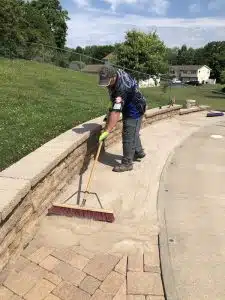
Paver restoration can substantially improve appearance, but weathering, permanent stains, and existing damage may remain. Heavy growth can hide defects that only become visible after cleaning, so homeowners should expect some surprises once the surface is exposed. According to Perfect Pavers, paver restoration addresses roughly 80 percent of paver problems and costs three to four times less than laying a new pavement. Every property differs, but that gives a useful sense of the practical case for paver restoration over replacement.
The typical sequence follows a logical order. Assessment comes first, then cleaning, then re-leveling or replacing pavers where needed, then refilling joints, and finally ongoing maintenance. Amazing Paver Restoration describes the same six-step pattern: assessment, cleaning, re-leveling or replacing pavers, refilling joints with polymeric sand, sealing, and ongoing maintenance. Knowing that sequence helps homeowners understand what the work involves and why each step matters.
How do you keep pavers looking good after paver restoration?
Routine care keeps restored pavers in good condition. Joints should be kept topped off as material settles or washes out. Organic growth should be managed early, before it spreads across the surface. According to Perfect Pavers, drainage trays should be cleared of debris twice a year: once in spring after snowmelt and once in fall after leaf fall. That simple step prevents water from backing up onto the pavement.
An appropriate EcoGuard maintenance program helps slow the return of algae, moss, and other biological growth after cleaning or paver restoration. EcoGuard is a maintenance treatment, not a sealant and not a one-time fix. Re-treatment intervals depend on exposure and usage, and maintenance is ongoing rather than permanent. Homeowners who want a clear picture of their patio or walkway can request a free paver assessment to determine whether the surface needs cleaning, joint renewal, repairs, or a combination.
Key Takeaways
- Tired pavers usually have more than one problem at once, and growth, staining, missing joint material, settlement, and drainage each need a different solution.
- "Brick pavers" can mean concrete pavers or fired-clay brick, and the material should determine the cleaning and restoration method.
- Excessive pressure and improper technique can damage paver surfaces and displace joint material, so the method should match the paver and the goal.
- Cleaning will not fix sinking pavers, loose edges, uneven steps, or poor drainage; those conditions need evaluation and a separate repair scope.
- Polymeric and resin jointing products have different requirements, and new sand over old is not automatically appropriate.
- Restoration can substantially improve appearance, but weathering, permanent stains, and hidden defects may remain after cleaning.
- Routine care and an appropriate EcoGuard maintenance program help manage recurring organic growth, but maintenance is ongoing, not permanent.
References
- Restoring old pavers — 2025-06-15
- How To Restore Faded Pavers: A Comprehensive Guide — date unknown
- Paver Restoration: 3 Proven Techniques — date unknown
- How to Restore a Paver Patio — 2025-05-02
